
Featured project
Setupuram AI Data Centre
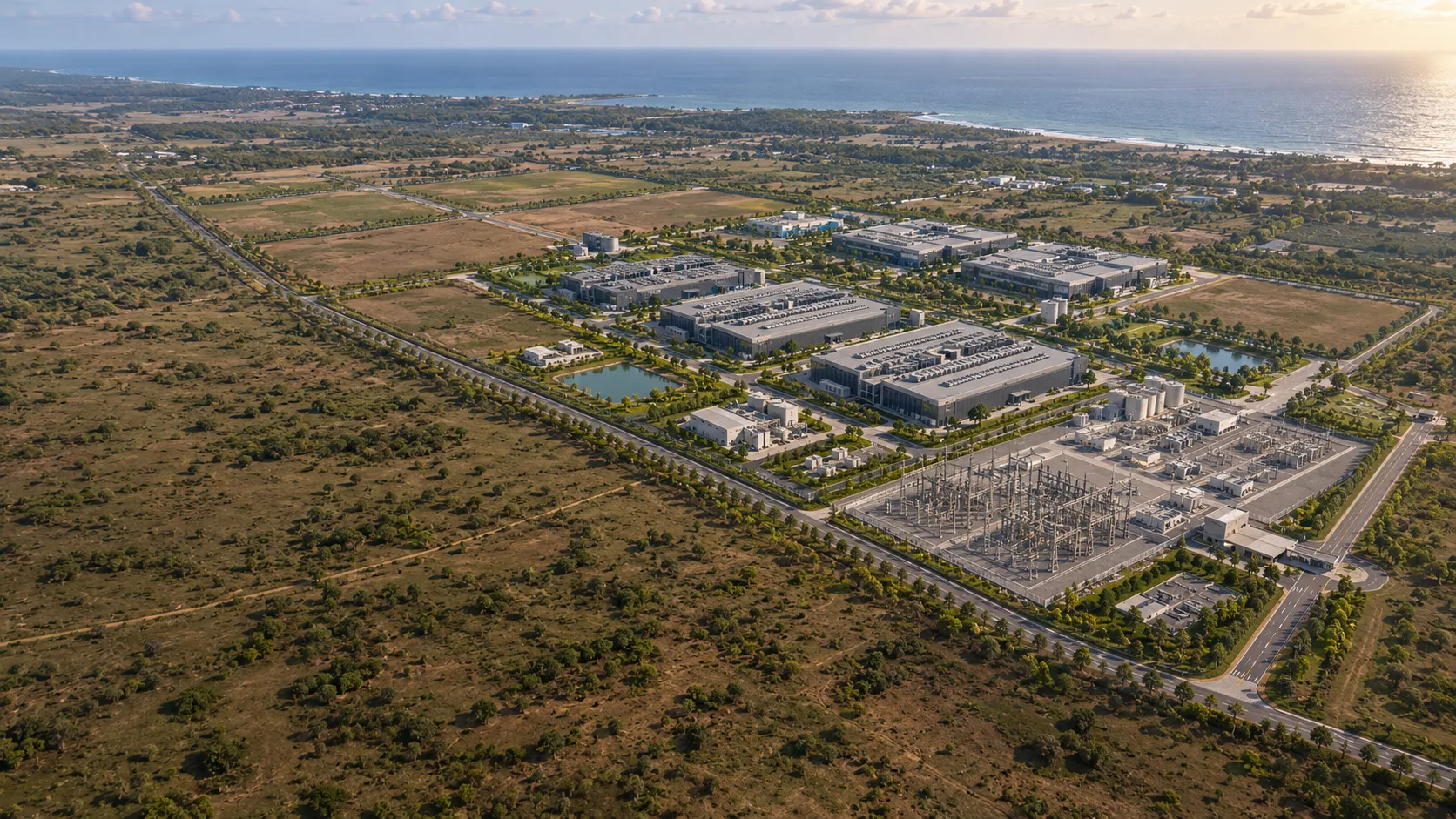
Conceived and architected by Tech Innovations: a proposed AI-ready data centre campus on the southern coast of Tamil Nadu, at the pre-feasibility stage. Tech Innovations invites the right partners into the consortium that will deliver it.
The project in seven facts
These are the figures the project is planned on. Each carries the status the project's own report gives it: a fact is established, a decision is the project's own, a target is what the design is working to, and an estimate will be confirmed by study.
1. Location
Setupuram, Mandapam block, Ramanathapuram district, Tamil Nadu, about 3 to 5 km west of Mandapam town on the mainland approach to the Pamban Bridge.
Fact
2. Capacity
Phase 1 is 100 MW of total facility power, about 83 to 91 MW of IT load at a PUE of 1.10 to 1.20. The site has land to expand in stages beyond Phase 1; the capacity of later phases will be set by engineering studies.
Decision; IT load an estimate
3. Land
200 contiguous coastal acres, contributed by Setupuram Limited, the founding member of the consortium. Land-related agreements and approvals are subject to legal verification.
Fact
4. Investment
Up to US$1 billion for the infrastructure of Phase 1, excluding the computing equipment that tenants bring. No commitment or financial close is implied; financing follows the studies, operator selection and an anchor tenant.
Decision
5. Cooling
Seawater-assisted, through titanium plate heat exchangers and a sealed coolant loop, with dry-cooler back-up, so that no drinking water is used for primary cooling. The intake and discharge locations will be chosen through a marine survey and coastal engineering studies.
Target
6. Stage
Pre-feasibility. The land is held and the proposition is set out; the detailed studies (transmission, coastal zone demarcation, marine survey, title and boundary, geotechnical and flood, cost estimate, market study) run next, in parallel, alongside the State's agreement in principle and the forming of the consortium.
Decision
7. Structure
A development consortium now, built and led by Tech Innovations under confidentiality agreements and a members' memorandum; a project company next, led by the developer-operator Tech Innovations selects, with the co-investors and lenders it brings in, Setupuram Limited holding the land interest and Tech Innovations the development interest.
Decision
What the campus is
The campus is designed as AI-ready infrastructure: land, high-voltage power, liquid cooling, security, connectivity and the buildings that hold them. In the industry's language it is the landlord's side of the business. The computing equipment that runs inside it is brought by tenants: AI cloud operators, hyperscale cloud providers, sovereign and government AI programmes, and large enterprises. The infrastructure envelope covers the first; the compute investment that follows is several times larger.
Four things distinguish the proposal. The land is assembled in one contiguous block of a size now rare near the Tamil Nadu coast. The coast offers a heat sink that allows the campus to reject heat into the sea through sealed exchangers instead of evaporating freshwater. The site lies on the southern coast of a state that already hosts India's second-largest data-centre market at Chennai. And the project is organised as a consortium, so that each part of the work is led by a partner with the track record to deliver it.

The full public story of the site, the physics of AI infrastructure, how the sea carries the heat, and the two-minute films, is on setupuram.ai.
Who is involved

Tech Innovations conceived the project and architected it, and it owns the project's development: the vision, the architecture, the consortium and the decisions on who takes part. It leads the engagement with the State, commissions and manages the studies, controls what is shared and with whom, runs the programme office and will select the developer-operator, co-investors and lenders that lead the project company.
Setupuram Limited is the founding member of the consortium. Its contribution is the land: ownership, land-related agreements, site access and support for land-use, coastal and other approvals.
Every other participant, present and future, joins a consortium that Tech Innovations built and leads. Mahesh Ramachandran, Project Director, leads the project for Tech Innovations.
What the project needs now
The first partners
The first partners the project is approaching are those whose work produces evidence the others need: a transmission study and consultant, a coastal and marine team, title and lead counsel, a master planner, a cost consultant, a market adviser, and a developer-operator. Other roles follow as the site becomes powered, permitted and financeable.
Tech Innovations has begun informal conversations with prospective partners across several tracks. Every partner area is open to a capability submission now, and Tech Innovations decides how to proceed. Each area is labelled with the stage at which Tech Innovations expects to engage it, so that an organisation can see whether its role is a priority engagement or a later phase before it writes anything.
Nothing on this page is an offer of securities, a tender, or a statement that any partner, tenant, investor, lender, approval, power connection or incentive has been secured. The project report on which these facts rest is available to qualified organisations by request after screening; see Resources.