

Partner track 3 of 9
Compute and digital technology
Tenants bring the computing equipment; the campus must be designed to the standards they buy to.
The opportunity
A campus designed from the first rack to the standards tenants buy to: chips, servers, networks and liquid cooling. Technology partners shape the design so the campus is ready for the equipment that will fill it.
What we expect
Chip, server and network companies with reference designs, certification programmes or deployment standards, engaged as the design advances. Register interest now.
What to send
Your product range, the standards or reference designs you certify to, and one data-centre deployment at scale, in a sentence each.
Why this track matters to the project
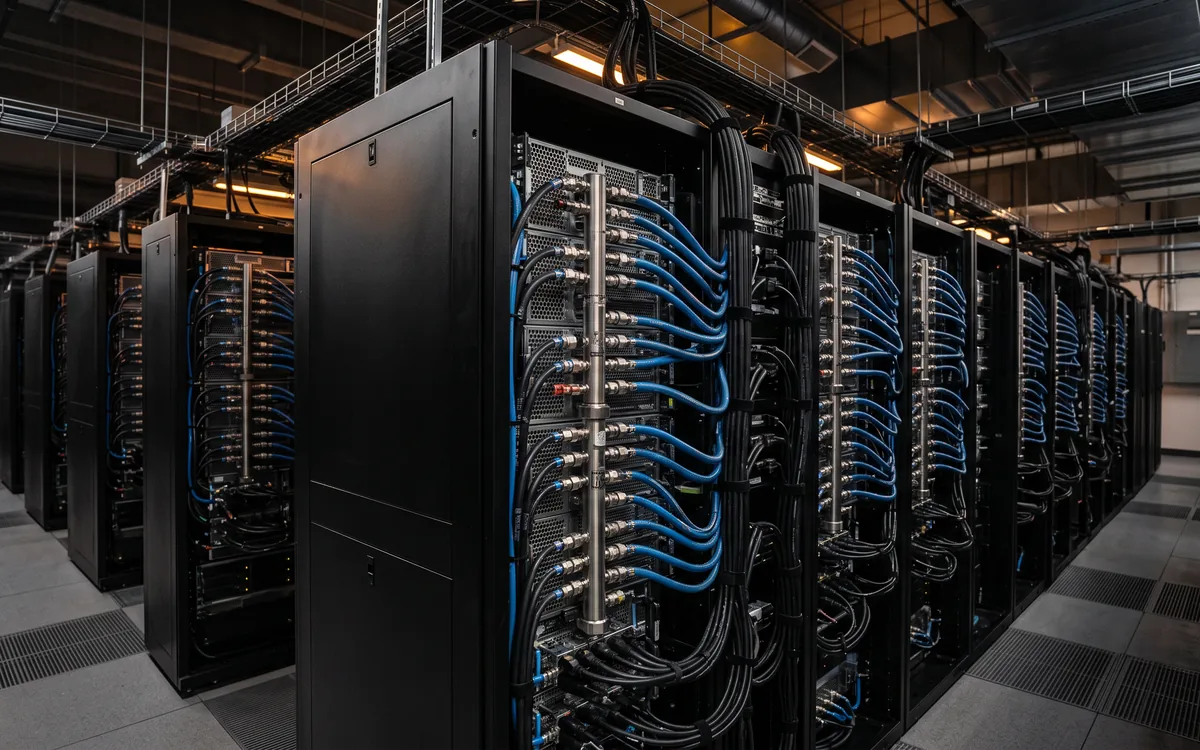
Tenants bring the computing equipment; the campus must be designed to the standards they buy to. Chip reference designs and certification programmes, server rack designs that fix floor loading, manifolds and coolant interfaces, and the campus optical layer all shape the basis of design before any equipment is ordered.
Disciplines in this track
Each discipline carries the stage at which Tech Innovations expects to engage it. Priority engagement means Tech Innovations is approaching this discipline before financial close. Register interest for a later phase means a submission is welcome now and is held until the project reaches that stage.
Chips and accelerators
Chip makers do not invest in campuses, but their reference designs and certification programmes set the standard tenants buy to.
Register interest for a later phase
Servers and systems
Server makers supply tenants, not the campus, but their rack designs fix floor loading, manifolds and coolant interfaces.
Register interest for a later phase
Networking
The operator owns the campus optical layer and meet-me rooms; tenants buy their own compute fabrics.
Register interest for a later phase
What we ask you to show
Before anything else, the capability submission asks for up to three comparable assignments, completed or in operation, with the year, location, your role, the scale in the measure that fits your discipline, the status and a way to verify it. Newer specialist firms may present documented pilots and the founding team's record instead, clearly labelled. Then, for this track:
- Chips and accelerators
- Products qualified for liquid cooling, reference architectures, partner certification, serviceability and lifecycle, Indian field support, and any supply or export constraints.
- Servers and systems
- Liquid-cooled racks delivered, cluster integration and burn-in, high-density references, OEM support terms, spares, and installation scale and logistics.
- Networking
- High-speed fabric deployment references, optics and throughput, architecture and routing, security, monitoring and redundancy.

What happens next
This track is engaged at the ecosystem stage, once the operator and the basis of design are in place. Submissions are held and acknowledged, and Tech Innovations contacts the organisations it has screened when the engineering envelope and reference-design interfaces are ready to share.
Make a capability submission
Comparable work first. Screening by people. Nothing committed on either side until the document that records it says so.
Chip vendors, server makers and cloud companies enter through defined technical or commercial roles; their presence does not establish investment or tenancy. No proprietary vendor material is requested at this stage. Tech Innovations decides how to proceed at every stage. A capability submission creates no entitlement to selection, consortium membership, contract award, equity or access to project information. Organisations must disclose conflicts of interest.